 ultimate-guide
Epoxy Flooring for Heavy Industrial Traffic: A 2026 Guide
Table of Contents
- Why Epoxy Flooring Dominates Heavy Industrial Environments
- Impact and Abrasion Resistance: What Your Floor Faces Daily
- Industrial Epoxy Floor Coating Thickness and Load-Bearing Capacity
- Chemical and Spill Resistance in Manufacturing Settings
- Epoxy vs Polyaspartic for Industrial Use: Which Performs Better
- Installation, Surface Preparation, and Substrate Diagnostics
- Epoxy Floor Maintenance for Warehouses and High-Traffic Facilities
- Lifecycle Cost Analysis and ROI for Industrial Epoxy Systems
- Frequently Asked Questions
Last Updated: September 27, 2026
Why Epoxy Flooring Dominates Heavy Industrial Environments
Heavy industrial facilities face relentless demands on their floors. Forklifts, pallet jacks, and equipment weighing thousands of pounds move across concrete surfaces daily. Chemical spills happen. Temperature swings occur. The floor must survive it all without failing.
Epoxy flooring for heavy industrial traffic delivers what standard concrete cannot: a protective barrier engineered to absorb impact, resist chemicals, and maintain structural integrity under extreme conditions. Unlike bare concrete, which absorbs liquids, cracks under stress, and deteriorates within years, epoxy creates a seamless, impermeable surface that extends floor life significantly.
The difference matters in warehouses, manufacturing plants, distribution centers, and any facility where equipment traffic never stops. A floor failure means production halts. Downtime costs multiply fast. The right epoxy system prevents that scenario entirely.
At Concrete Renovations, we've installed durable epoxy flooring across various spaces. The systems we specify are built for heavy traffic, chemical exposure, and the thermal shock that comes with industrial operations. The approach starts with substrate diagnostics, understanding what's beneath the surface, then selecting the right epoxy thickness and formulation for the specific load and environment.
Impact and Abrasion Resistance: What Your Floor Faces Daily
Industrial equipment creates two distinct wear patterns: concentrated impact from dropped loads and distributed abrasion from constant traffic. A floor system must handle both.
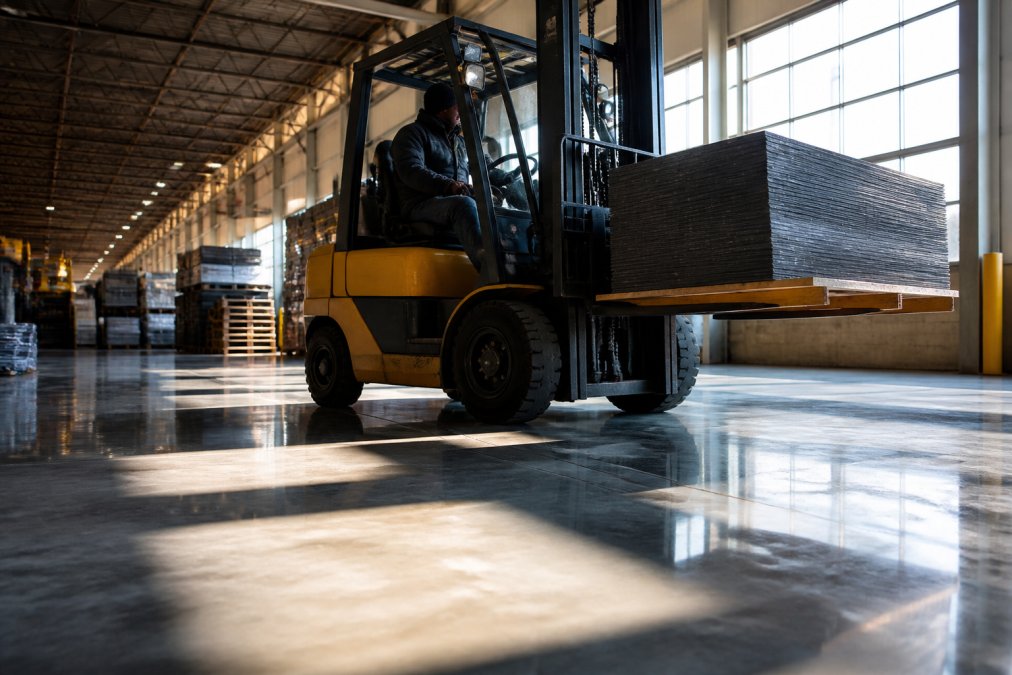
Impact resistance measures how well a surface absorbs sudden shock without delaminating or cracking. A pallet jack dropping a load, a forklift tire hitting a pothole in the concrete, these events create localized stress. Epoxy formulations designed for heavy industrial traffic include impact-absorbing resins that flex slightly rather than shatter. This flexibility prevents the coating from separating from the substrate.
Abrasion resistance tracks surface wear from constant sliding, rolling, and friction. Forklifts moving thousands of times per month create cumulative wear. The right epoxy maintains its finish and protective properties even after years of this traffic. Polyester and polyurethane components in premium industrial epoxy systems resist surface degradation that would leave bare concrete exposed and vulnerable.
The compressive strength of industrial epoxy means it can support concentrated loads without permanent deformation. Combined with proper tensile strength, the ability to resist pulling forces, the coating stays bonded to the substrate even as the building settles or temperature fluctuations occur.
A common mistake is choosing epoxy based on appearance rather than wear performance. A glossy finish looks professional but may not deliver the abrasion resistance a high-traffic facility needs. The best systems balance durability with functionality.
Industrial Epoxy Floor Coating Thickness and Load-Bearing Capacity
Coating thickness directly determines load-bearing capacity. Thinner coatings cost less but fail faster under heavy traffic. Thicker systems cost more upfront but outlast cheaper alternatives by years.
Industrial epoxy for heavy industrial traffic typically requires a minimum thickness of 100 mils (0.1 inches) for light commercial use, but heavy industrial applications demand 150 to 250 mils or more. This high-build coating creates a protective barrier thick enough to absorb impact, bridge minor concrete imperfections, and distribute weight across a larger surface area.
The substrate matters equally. Concrete that's properly cured, free of moisture, and structurally sound supports thicker coatings effectively. Moisture vapor transmission, the movement of water through concrete, is the primary reason epoxy fails prematurely. If moisture reaches the epoxy-concrete interface, the bond fails, and the coating delaminates. Moisture testing before installation is non-negotiable.
Load distribution depends on both coating thickness and aggregate selection. Some industrial epoxy systems include quartz aggregates or ceramic particles that increase surface friction and create micro-texture. This texture distributes weight more evenly than smooth epoxy alone, reducing stress concentration points.
A facility with heavy forklift traffic, machinery vibration, and thermal cycling needs appropriate thickness. Concrete Renovations conducts substrate diagnostics to determine the right thickness specification for your specific traffic patterns and environmental conditions.
Chemical and Spill Resistance in Manufacturing Settings
Manufacturing and industrial environments expose floors to oils, solvents, acids, and caustics. Standard concrete absorbs these chemicals, deteriorates from the inside, and fails structurally. Epoxy creates a chemical barrier that prevents absorption.
Chemical resistance depends on the resin type and topcoat formulation. Epoxy resins themselves resist most common industrial chemicals, but some solvents and aggressive caustics require specialized formulations. Polyaspartic topcoats, for example, offer chemical resistance compared to standard epoxy topcoats, particularly against strong acids and alkalis.
The seamless finish of epoxy flooring eliminates the grout lines and porous edges that plague tile or concrete. Spills stay on the surface, making cleanup immediate and preventing chemical penetration into the substrate. This containment property is critical in facilities where spill protocols are strict and environmental compliance is non-negotiable.
Static control is another consideration in chemical manufacturing. Some epoxy systems incorporate conductive elements that dissipate static electricity, preventing ignition hazards in facilities handling flammable materials. This feature adds cost but is essential in certain industries.
Maintenance of chemical resistance requires regular cleaning with appropriate products. Acidic cleaners can etch some epoxy formulations, while alkaline cleaners may cause discoloration. Concrete Renovations provides guidance on maintenance protocols that preserve chemical resistance for the life of the floor.
Epoxy vs Polyaspartic for Industrial Use: Which Performs Better
The choice between epoxy and polyaspartic topcoats shapes floor performance and installation timeline. Both offer distinct advantages.
Epoxy flooring for heavy industrial traffic uses epoxy resin as the base, typically with a polyurethane or epoxy topcoat. Epoxy cures slowly, allowing time for proper application and surface leveling. This extended cure window makes epoxy easier for contractors to install correctly. The finished surface is hard, durable, and resistant to most chemicals and mechanical wear.
Polyaspartic systems cure much faster, allowing facilities to return to service quickly.
| Characteristic | Epoxy | Polyaspartic |
|---|---|---|
| Cure Time | 24-72 hours | 4-8 hours |
| Cost | Lower | Higher |
| Chemical Resistance | Excellent | Excellent |
| UV Resistance | Moderate | Superior |
| Application Difficulty | Moderate | High |
| Best For | Indoor heavy traffic | Fast turnaround, outdoor use |
Installation, Surface Preparation, and Substrate Diagnostics
Installation quality determines whether an epoxy floor performs or fails. The process begins long before the resin is mixed.
Epoxy Floor Maintenance for Warehouses and High-Traffic Facilities
Once installed, epoxy requires regular maintenance to preserve performance. The maintenance cycle depends on traffic volume and environmental conditions.
Lifecycle Cost Analysis and ROI for Industrial Epoxy Systems
Initial cost is not the same as total cost. An industrial epoxy floor costs more upfront than bare concrete but delivers significant savings over its lifespan.
Frequently Asked Questions
What makes epoxy flooring suitable for heavy industrial traffic?
Epoxy flooring creates a hard, seamless surface that resists impact, abrasion, and chemical spills. Its compressive strength and tensile strength withstand forklift traffic, dropped equipment, and constant foot traffic without cracking or peeling. The resinous coating bonds directly to the concrete substrate, distributing loads evenly across the floor and preventing localized failure under heavy-duty operations.
What industrial epoxy floor coating thickness do I need for warehouse operations?
Heavy industrial facilities typically require appropriate thick epoxy coatings. Thicker applications provide superior impact absorption and load-bearing capacity for operations with constant forklift traffic or heavy equipment. Thinner coatings suit light to moderate traffic. A concrete renovation specialist can assess your substrate condition and traffic patterns to recommend the optimal thickness for your specific operation.
How does epoxy compare to other industrial flooring options like polyurethane?
Epoxy vs polyaspartic for industrial use shows distinct trade-offs. Epoxy offers excellent chemical resistance, lower cost, and proven durability in most warehouses. Polyaspartic coatings cure faster (allowing quicker facility reopening) but cost more. Polyurethane provides flexibility in temperature-shock environments. For most heavy traffic warehouses, epoxy delivers the best balance of performance and value, while polyaspartic suits operations requiring minimal downtime.
What are the main maintenance requirements for high-traffic industrial epoxy floors?
Epoxy floor maintenance for warehouses includes regular sweeping to remove abrasive debris, wet cleaning with pH-neutral detergents, and prompt spill containment to prevent chemical damage. Avoid acidic cleaners and high-pressure washers that can degrade the coating. Inspect for cracks or wear; minor damage caught early prevents substrate exposure. Most industrial epoxy floors need resealing periodically depending on traffic intensity and chemical exposure.
How long does industrial epoxy flooring typically last under heavy use?
Well-installed epoxy flooring in heavy industrial settings lasts a significant time with proper maintenance. Durability depends on traffic volume, chemical exposure, substrate quality, and coating thickness. Facilities with extreme conditions (constant chemical spills, heavy impact) may see shorter lifespans, while controlled environments may see longer. Lifecycle cost analysis shows epoxy's long lifespan delivers strong ROI compared to frequent replacement of lesser coatings.
What substrate preparation is critical before epoxy installation?
Proper surface preparation determines epoxy success. Concrete must be cleaned, degreased, and mechanically profiled using diamond grinding or shot blasting to open the substrate's pores. Moisture vapor transmission testing identifies moisture issues that cause epoxy failure. Substrate failure diagnostics catch cracks, spalling, or poor subgrade conditions before coating. Skipping these steps leads to peeling and premature failure, professional surface preparation is non-negotiable for industrial applications.
Does epoxy flooring meet industrial safety and slip-resistance standards?
Epoxy flooring can meet OSHA and ANSI slip-resistance standards when specified with aggregate additives or textured topcoats. Static-control epoxy variants protect electronics-sensitive facilities. Specify slip resistance based on your operation's hazard level and regulatory requirements, your concrete renovation partner can ensure compliance during design.