 listicle
Average Cost for Residential Concrete Driveway
Table of Contents
- What Homeowners Pay for Concrete Driveways
- Concrete Driveway Cost Per Square Foot
- Concrete vs. Asphalt Driveway Cost Comparison
- Material and Labor Cost Breakdown
- Key Factors That Affect Your Driveway Cost
- Residential Concrete Driveway Installation Timeline
- Hidden Costs and Additional Expenses
- Maximizing Your Driveway Investment
- Frequently Asked Questions
Last Updated: September 28, 2026
What Homeowners Pay for Concrete Driveways
The average cost for residential concrete driveway varies significantly based on size, location, and the specific choices you make during installation.
Concrete remains popular because it balances durability with affordability, lasting 25-30 years with proper maintenance.
Price depends on square footage, local labor rates, site conditions, and finish options.
Concrete Driveway Cost Per Square Foot
Cost per square foot is the most useful metric for comparing projects and scaling costs to your driveway's dimensions.
Cost per square foot varies by finish type, reinforcement, and site accessibility. Broom-finished driveways cost less than stamped or exposed aggregate options. Thicker slabs with rebar or wire mesh increase costs due to additional material and labor.
Local labor costs, site access, and soil conditions affect pricing. Spring and summer typically command higher rates than fall and winter.
Concrete vs. Asphalt Driveway Cost Comparison
Asphalt has lower upfront costs but requires seal coating every 2-3 years and repairs within 10-15 years. Concrete costs more initially but requires less frequent maintenance.
Here's how the materials compare across key factors:
| Factor | Concrete | Asphalt |
|---|---|---|
| Initial Installation | Higher upfront cost | Lower upfront cost |
| Lifespan | 25-30 years | 10-15 years |
| Maintenance | Minimal; occasional sealing | Frequent seal coating & repairs |
| Appearance | Maintains color; can be decorated | Darkens with age; requires resealing |
| Climate Durability | Excellent in freeze-thaw cycles | Softens in extreme heat; cracks in cold |
| Resale Value Impact | Increases curb appeal | Minimal impact |
Concrete offers better long-term value for homeowners staying 15+ years. Total cost of ownership, including maintenance, typically favors concrete despite higher initial cost.
Material and Labor Cost Breakdown
Understanding what you're actually paying for helps you evaluate contractor quotes and spot potential overcharges.
Material Costs
Concrete mix represents only a portion of material expenses. Reinforcement materials, finishing agents, and sealers add to the bill.
Delivery fees vary by distance from suppliers and truck minimums. Ask whether delivery is included in quotes or itemized separately.
Decorative finishes increase material costs. Stamped concrete requires special molds and colorants; exposed aggregate needs selected stones. Broom finishes use materials already in the basic mix.
Labor Costs
Labor typically represents 40-50% of total cost and includes site preparation, forming, pouring, finishing, and curing oversight. Skilled finishers command higher rates because their work directly affects appearance and longevity.
Labor rates vary by region and contractor experience. Established contractors often charge more but typically deliver better results and fewer costly mistakes.
Complexity increases labor costs. Curved driveways, slopes, multiple access points, difficult site access, and steep grades require more careful planning and longer work.
Key Factors That Affect Your Driveway Cost
Multiple variables influence your final bill. Understanding each one helps you make smart choices about where to invest and where you might compromise.
Climate and Regional Durability Costs
Geographic location impacts both initial installation price and long-term maintenance. Ignoring climate-specific requirements leads to premature failure and costly repairs.
Freeze-thaw regions require deeper sub-bases and thicker slabs (5-6 inches versus standard 4 inches) to prevent heaving and cracking. Air-entrained concrete with tiny air bubbles is essential and costs slightly more than standard concrete.
Superior drainage is essential in freeze-thaw regions. Proper gravel sub-base depth (6-8 inches in freeze-thaw zones) and perimeter drainage prevent water expansion damage.
Hot, arid climates cause concrete to expand and contract dramatically, increasing crack risk. UV exposure requires more frequent sealing (every 1-2 years). Lighter-colored or reflective sealers reduce heat absorption and extend slab life.
Humid coastal regions expose concrete to salt spray and moisture. Premium sealers and more frequent resealing (annually in some cases) are necessary. Epoxy-coated rebar prevents corrosion.
Regional labor and material price variations:
Concrete prices fluctuate by region based on local supply and demand. Urban areas see lower costs than rural areas, creating regional material cost differences.
Labor rates vary dramatically by region, with metropolitan areas commanding higher hourly rates than rural areas.
Permit and inspection fees vary by jurisdiction. Check local requirements before requesting quotes to prevent surprise fees.
Site Preparation and Excavation
Existing driveway condition or soil quality significantly affects total cost. Demolition and haul-away require heavy equipment and disposal fees.
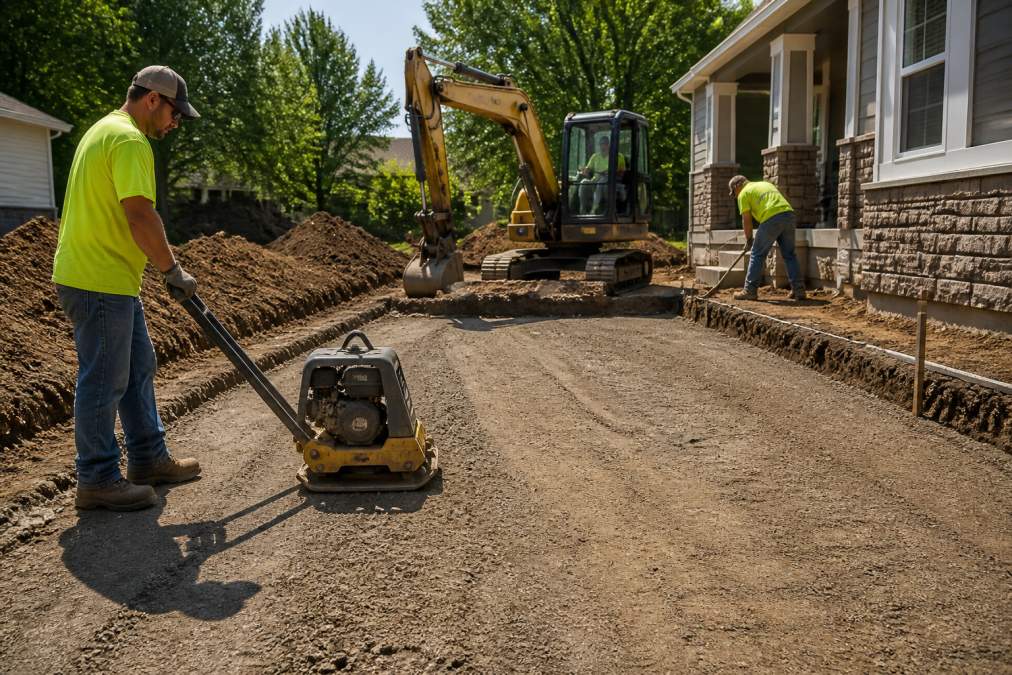
New sites need proper grading and compaction. The sub-base must be correctly prepared to prevent settling and cracking. Poor soil conditions require additional fill material and drainage improvements.
Excavation depth depends on climate and intended use. Freeze-thaw regions need deeper sub-bases; heavy-vehicle driveways need more substantial preparation.
Thickness and Reinforcement
Standard driveways are 4 inches thick for passenger vehicles; thicker slabs (5-6 inches) support heavy trucks or RVs. Reinforcement adds cost but improves durability and crack resistance.
Wire mesh is the less expensive option for standard applications. Rebar provides superior strength for high-traffic areas or poor soil conditions.
Proper reinforcement spacing and installation matter as much as material choice. Contractor experience directly affects final results.
Finish Options
A broom finish provides traction and costs nothing extra. It's the standard choice because it's practical and affordable.
Stamped concrete creates decorative patterns that mimic stone, brick, or tile. It costs more because it requires special equipment and skilled finishing work. Stamped finishes enhance curb appeal and can increase your home's perceived value.
Exposed aggregate finishes reveal decorative stones embedded in the concrete surface. They're more expensive than broom finishes but less costly than stamped options. They provide excellent traction and a distinctive appearance.
Colored concrete adds visual interest without the cost of stamped patterns. Integral colorants mixed into the concrete provide consistent color throughout. Surface-applied stains offer another option for adding color to existing concrete.
Residential Concrete Driveway Installation Timeline
Understanding the project schedule helps you plan for disruptions and know when your driveway will be ready to use.
Most concrete driveway installations take 2-5 days from start to finish, depending on size and complexity. Site preparation might take an additional day if significant excavation or demolition is needed.
The actual concrete pouring happens quickly, often in a single day for residential driveways. The real time commitment comes afterward. Concrete must cure properly before you can use it. Initial set takes about 24-48 hours, but full cure requires 7 days. Many contractors recommend waiting 7 days before driving on new concrete, though some allow light traffic after 3 days.
Weather affects the timeline significantly. Rain delays curing and can compromise concrete quality. Extreme temperatures slow the curing process. Contractors typically avoid pouring concrete during heavy rain or when temperatures drop below 50°F.
Seasonal factors influence scheduling. Spring and summer offer ideal conditions for concrete work. Fall and winter projects take longer and cost more because weather cooperation is less certain. Planning your driveway project for late spring or early summer typically means faster completion and better results.
Hidden Costs and Additional Expenses
Beyond the concrete and labor, several expenses catch homeowners off guard. Planning for these prevents budget overruns.
Demolition and Haul-Away
Removing an existing driveway is often the largest hidden expense homeowners encounter. The process involves multiple cost layers that vary significantly based on driveway size, condition, and local disposal infrastructure.
Breaking down demolition costs:
Heavy equipment rental and operation typically represents 30-40% of demolition expenses. A standard concrete saw (to cut the slab into manageable sections) costs $150-$300 per day to rent. Excavators or skid-steer loaders needed to break up and load concrete run $200-$400 per day.
Factors that increase demolition costs:
Permits and Inspections
Most jurisdictions require permits for driveway work. Permit costs vary by location and driveway size. Inspections ensure the work meets local building codes for drainage, thickness, and reinforcement.
Maximizing Your Driveway Investment
Your concrete driveway is a significant investment in your property. Making smart choices now protects that investment long-term.
Frequently Asked Questions
How much does a concrete driveway cost for a typical residential property?
The cost of a residential concrete driveway depends on square footage, site conditions, and finish type. Pricing varies based on your location, soil conditions, and whether you need demolition of an existing driveway. Contact Concrete Renovations for a free estimate tailored to your specific project, as we offer competitive pricing based on fair market rates and your property's unique requirements.
What is the concrete driveway cost per square foot?
Per-square-foot pricing for concrete driveways is affected by labor rates in your area, material quality, reinforcement needs, and finish complexity. Standard poured concrete typically costs less than decorative finishes like stamped or exposed aggregate. Your actual cost per square foot will depend on site preparation, thickness requirements, and local contractor rates. Get a precise quote by contacting Concrete Renovations with your driveway dimensions.
Is concrete or asphalt cheaper for a driveway?
Asphalt typically has a lower upfront cost than concrete, but concrete lasts significantly longer and requires less frequent maintenance. While asphalt may be cheaper initially, concrete's durability means fewer repairs over time, making it a better long-term investment. Concrete also adds more curb appeal and property value. Your choice depends on your budget timeline and how long you plan to stay in your home.
How long does a residential concrete driveway installation take?
A typical residential concrete driveway installation takes 5-10 days from start to finish, including site preparation, pouring, and curing time. Site prep and excavation can take 1-2 days depending on existing conditions. The concrete itself requires 7 days of curing before full use, though light foot traffic is possible after 48 hours. Complex projects or poor weather may extend the timeline. Concrete Renovations ensures prompt project completion with professional workmanship.
What's included in the total cost of a concrete driveway project?
Total costs typically include materials (concrete, reinforcement, aggregate), labor, site preparation and excavation, finishing, sealing, and sometimes demolition of old pavement. Additional expenses may include permits, inspections, drainage adjustments, and haul-away fees. Decorative finishes like stamped concrete or exposed aggregate add to the base cost. Our team at Concrete Renovations provides detailed cost breakdowns during the estimation process to ensure transparency.