 blog
blog
Residential Epoxy Flooring vs Polished Concrete: 2026 Guide
Table of Contents
- Epoxy vs Polished Concrete: A Side-by-Side Comparison
- Durability, Impact, and Chemical Resistance
- Epoxy Flooring Cost Per Square Foot vs Polished Concrete
- Pros and Cons of Epoxy Garage Floors
- Polished Concrete Maintenance Tips and Cleaning Routines
- Installation, Climate, and Repair: What Northeast Florida Homeowners Should Know
- Resale Value and the Right Choice for Your Home
- Frequently Asked Questions
Last Updated: September 20, 2026
Epoxy vs Polished Concrete: A Side-by-Side Comparison
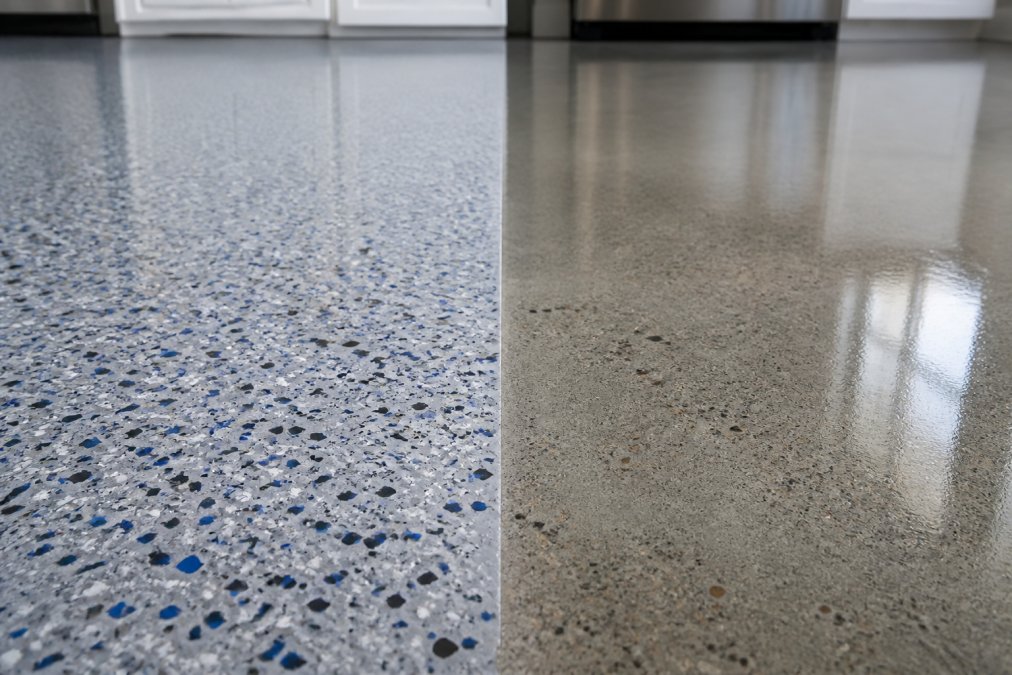
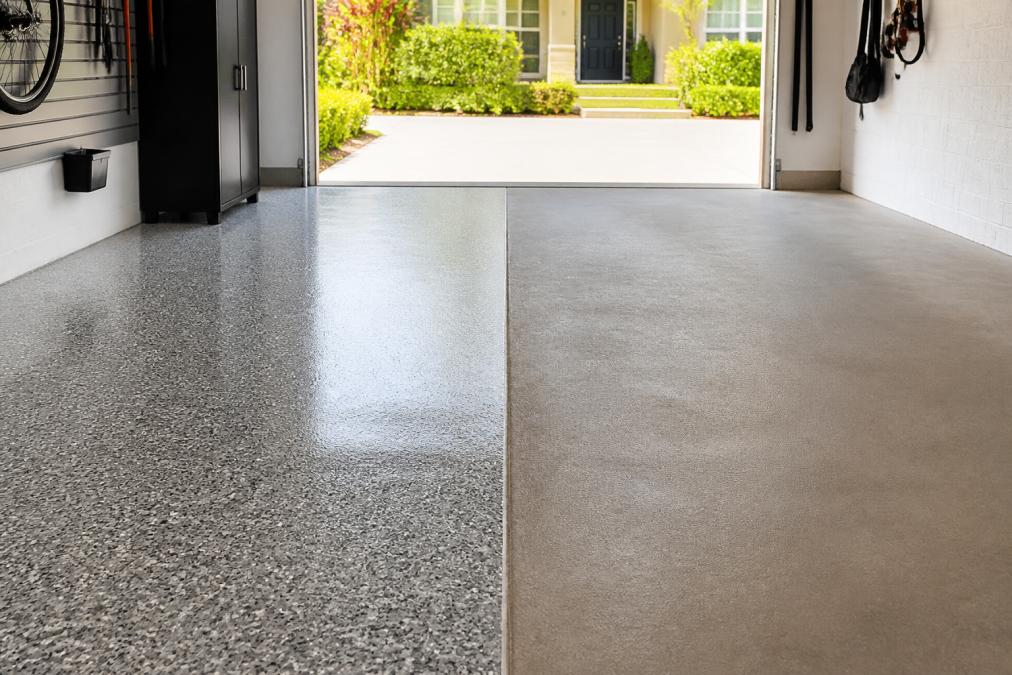
Choosing between residential epoxy flooring vs polished concrete comes down to one question: do you want a coating or a finished slab? Epoxy is a resin coating applied over existing concrete. Polished concrete is the slab itself, ground and refined with diamond tooling until it shines. That single difference drives everything else, from cost to lifespan to how each floor handles a hot tire.
Quick Comparison Table
| Factor | Epoxy Coating | Polished Concrete |
|---|---|---|
| What it is | Resin layer over slab | Mechanically ground slab |
| Best for | Garages, workshops | Patios, living spaces |
| Finish options | High-gloss, flake, matte | Honed, high-gloss, matte |
| Stain resistance | High with urethane topcoat | High when densified |
| Repair difficulty | Patchable in sections | Harder to spot-repair |
| Typical lifespan | 5-15 years | Decades |
Durability, Impact, and Chemical Resistance
Polished concrete wins on raw durability because there's no coating to peel. Epoxy wins on chemical resistance at the surface. A densified, polished slab resists abrasion for decades, while epoxy's urethane topcoat shrugs off oils, salts, and most household chemicals. The trade-off: epoxy can delaminate if the slab wasn't prepped correctly, and polished concrete can etch if left sitting in acid.
Hot Tire Pickup and Abrasion Resistance
Hot tire pickup is the peeling you see when warm tires lift a coating off the slab. It's the single most common epoxy failure. The fix is surface preparation: mechanical grinding or diamond tooling to open the concrete's pores so the resin actually bonds. Skip that step and no coating holds.
Epoxy Flooring Cost Per Square Foot vs Polished Concrete
Epoxy flooring cost per square foot usually runs lower on the front end, but polished concrete often costs less over the life of the floor. Epoxy pricing depends on square footage, slab condition, coating system, and prep work. Polished concrete pricing depends on the aggregate exposure and finish level you choose. Neither is a flat number, and anyone quoting you one without seeing the slab is guessing.
Long-Term Maintenance Costs
A maintenance schedule changes the math. Epoxy needs recoating every several years depending on traffic, plus periodic cleaning with pH-neutral products. Polished concrete needs dust mopping and occasional re-burnishing, and it can be re-polished rather than replaced. Over a decade, the polished slab usually costs less to keep looking new.
Pros and Cons of Epoxy Garage Floors
The pros and cons of epoxy garage floors come down to finish and forgiveness. You get a seamless, customizable surface with epoxy flake, high-gloss or matte finish options, and strong chemical resistance. You also get a coating that can fail if the slab has moisture issues.
Pros:
- Wide aesthetic range, from solid color to decorative flake
- Excellent stain and chemical resistance with a urethane topcoat
- Lower upfront cost than many polished finishes
Cons:
- Can peel or delaminate without proper prep
- Sensitive to moisture vapor transmission from below the slab
- Needs recoating every few years
Polished Concrete Maintenance Tips and Cleaning Routines
Polished concrete maintenance tips start with one rule: keep grit off the surface. Dust mop or auto-scrub regularly, use pH-neutral cleaners, and avoid acidic products that etch the finish. A densifier keeps the surface hard, and a sealer adds a layer of stain protection.
Protecting the Finish Over Time
Re-burnishing restores gloss without recoating. For high-traffic commercial spaces, a maintenance schedule with periodic re-polishing keeps the slip coefficient in a safe range. If you want a honed finish instead of high-gloss, plan for a slightly different cleaning routine, since matte surfaces show smudges more.
Installation, Climate, and Repair: What Northeast Florida Homeowners Should Know
Humidity and heat decide which floor performs here, but the mechanism matters more than the slogan. Epoxy is a two-part thermoset resin: the amine or polyamide hardener reacts with the resin and cross-links into a solid film. That reaction is moisture-sensitive. When relative humidity is high or the slab is emitting vapor, the hardener reacts with water instead of resin, producing amine blush, cloudiness, and a weak bond line.
DIY vs. Professional Installation Risks
This is where the two floors diverge hardest, and where most articles stay vague. The failure modes are different in kind, not just degree.
- Acid etch instead of mechanical grind. Most kits instruct you to etch with muriatic acid. Etching opens the surface but leaves a profile that is far shallower than diamond grinding, and it does not remove laitance, curing compounds, or old sealer. The coating bonds to a weak layer and lifts.
- No moisture test. A plastic-sheet test taped to the slab for 24 hours is the minimum. If condensation forms, the slab is transmitting vapor and the epoxy will blister from below, a failure no manufacturer warranty covers.
- Wrong mix ratio or poor mixing. Part A and Part B must be combined at the exact ratio and mixed for the full time. Eyeballing the ratio or short-mixing leaves unreacted resin that never fully cures.
- Applying too thin or too thick. A single coat rolled thin wears through in traffic lanes; a coat poured thick traps solvent and bubbles.
Long-Term Repairability
Repairability is the quiet difference that shows up years later.
In a humid, hot climate, the single most expensive mistake is coating a slab that was never moisture-tested. Vapor transmission blisters epoxy from below, and no warranty covers a slab that was never tested. Test first, then decide.
Ask any contractor what prep method they will use before quoting. If the answer is "acid etch and roll," walk away. Proper epoxy bonding requires mechanical grinding with diamond tooling, not a chemical wash.
Climate and Freeze-Thaw
In this region, freeze-thaw is a minor concern compared with humidity, but it is not zero. Epoxy is a film, so it moves with the slab; if the slab cracks, the coating cracks with it unless a flexible membrane was used. Polished concrete is the slab, so it cracks when the slab cracks, the fix is to control cracking with joint layout and, where needed, a decorative saw-cut or semi-rigid joint filler.
Resale Value and the Right Choice for Your Home
Most articles on this topic wave at resale value and move on. The honest answer is that neither floor reliably adds a documented dollar figure to an appraisal, appraisers generally value finished square footage and condition, not the specific floor product. What a floor actually does at resale is influence how fast a home sells and how buyers perceive condition.
How Buyers Actually Read Each Floor
Epoxy in a garage. A clean, flake-finished epoxy garage reads as move-in ready and signals that the previous owner maintained the home. Buyers touring a garage with a peeling, hot-tire-lifted floor read the opposite. The floor does not add appraised value, but a failed one is a visible defect that invites price negotiation.
The Room-by-Room Decision
The practical rule is to match the floor to how the room is used, not to a trend:
- Garages and workshops: Epoxy, because chemical resistance and a seamless, cleanable surface matter most, and the aesthetic range (flake, metallic, solid) lets you match the home. Accept the recoat cycle.
- Patios, driveways, and covered outdoor areas: Polished or mechanically refined concrete, because it is the slab itself and handles weather, abrasion, and cleaning without a film to fail.
- Interior living areas, basements, and sunrooms: Polished concrete where the slab is sound and the design intent is modern and low-maintenance; epoxy only where a specific color or pattern is required and moisture is controlled.
The Repairability Question Buyers Ask Later
Resale value is not just the showing, it is the five years after. A buyer who inherits an epoxy floor inherits a recoat schedule. A buyer who inherits a polished slab inherits a maintenance routine (dust mopping, pH-neutral cleaners, periodic re-burnishing) but no recoating. Neither is free; both are predictable. Disclosing the maintenance rhythm at sale is a credibility move that prevents post-close disputes.
Do not buy either floor expecting an appraisal bump. Buy the floor that fits the room, holds up in this climate, and has a maintenance plan you will actually follow. That is what protects resale, a floor that still looks good on the day the buyer walks in.
Frequently Asked Questions
Is epoxy cheaper than polished concrete?
Epoxy typically costs less upfront than a full polished concrete system, but the gap narrows when you factor in reapplication. Polished concrete lasts decades with minimal rework, while epoxy usually needs recoating every 5 to 10 years depending on traffic. For a garage or commercial space, get a written quote for both so you can compare total cost over 10 years, not just the install price.
What is the downside of epoxy flooring?
Epoxy is sensitive to moisture vapor transmission in the slab. If the concrete was not properly prepped with mechanical grinding and a moisture test, the coating can delaminate or peel within a year. It also fades under intense UV exposure, so sun-facing patios are a poor fit. Hot tire pickup is another common complaint in garages, though a urethane topcoat reduces that risk.
Does polished concrete require more maintenance than epoxy?
Polished concrete usually needs less day-to-day maintenance. Dust mopping and occasional pH-neutral cleaning keep the surface looking sharp, and a densifier hardens the slab so it resists stains. Epoxy needs gentler cleaning to avoid dulling the finish, and it may need a recoat every few years. For busy households or commercial floors, polished concrete often wins on long-term upkeep.
Which option offers better slip resistance for residential garages?
Both can be tuned for grip. Epoxy is typically broadcast with aggregate or a slip-resistant additive, which gives reliable traction even when wet. Polished concrete slip resistance depends on the grit level of the final polish: a honed or matte finish has more texture than a high-gloss one. If your garage or patio sees rain or pool splash, ask your installer to specify a slip coefficient suited to wet areas.
The hardest part of this decision isn't picking a finish, it's trusting the crew that installs it. Poor surface preparation ruins both options, no matter which you choose. Concrete Renovations brings over 50 years of combined experience, certified and insured crews, free estimates, and a one-year warranty on all workmanship. Get a quote from Concrete Renovations and get a floor that holds up to Florida heat, humidity, and daily traffic.