 blog
Stamped vs Plain Concrete: Key Differences
Table of Contents
- What Is Stamped Concrete?
- What Is Plain Concrete?
- Stamped Concrete Patterns and Design Options
- Color and Finish: Stamped vs Plain Concrete
- Stamped Concrete Maintenance and Resealing
- Stamped Concrete Durability and Lifespan
- Plain Concrete Driveways: Durability and Care
- Installation, Labor, and Upfront Costs
- Frequently Asked Questions
Last Updated: October 12, 2026
What Is Stamped Concrete?
Stamped concrete is a decorative paving technique that imprints patterns and textures into freshly poured concrete before it hardens.
Stamping happens in a narrow window after the pour but before the concrete fully cures.
It's popular for patios, driveways, and walkways because it pairs concrete's durability with the look of pricier materials, and creates a seamless surface with no grout lines or gaps where weeds can grow.
What Is Plain Concrete?
Plain concrete, also called standard or regular concrete, is a simple, unadorned slab finished with a smooth or broom-finished texture.
It comes in one neutral color, typically gray, unless integral color is mixed into the batch.
Plain concrete is the baseline option, what most residential driveways, basement floors, and utility slabs look like. It prioritizes function over appearance and is the lowest-cost option upfront.
Stamped Concrete Patterns and Design Options
Stamped concrete patterns mimic natural stone, brick, pavers, slate, and even wood.
Common patterns include ashlar slate, random stone, cobblestone, herringbone brick, wood plank, and tile.
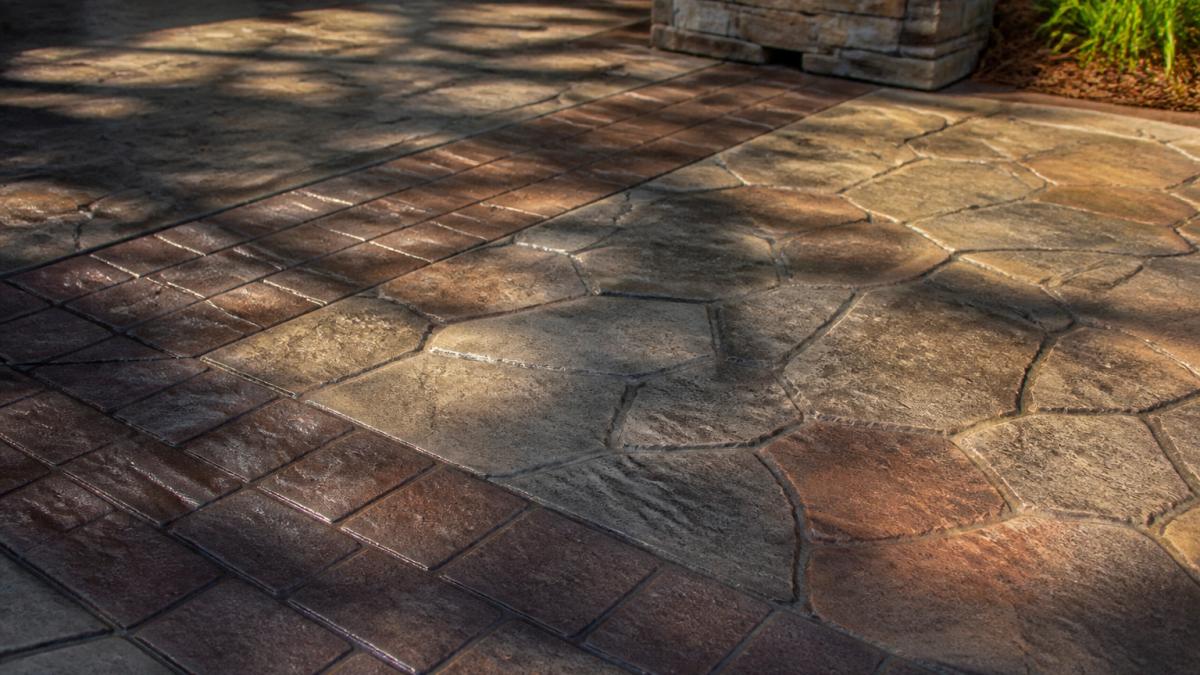
The limitation: all stamped patterns are surface-level, visual and tactile, but not structural.
Color and Finish: Stamped vs Plain Concrete
Stamped concrete offers far more color customization than plain concrete.
Plain concrete is limited to the natural gray of Portland cement unless integral color is added to the entire batch. Even then, plain concrete typically uses a single, uniform color.
Both benefit from a protective sealer, but it serves different purposes.
The finish texture also differs: stamped concrete has an intentional, designed texture from the stamp pattern, while plain concrete is smooth (polished or as-poured) or broom-finished for traction, fine parallel lines that lack a stamped pattern's visual complexity.
Stamped Concrete Maintenance and Resealing
Stamped concrete needs regular maintenance to preserve its appearance and durability.
Resealing means cleaning the surface thoroughly, letting it dry completely, and applying a new coat.
Between resealing cycles, clean regularly to remove dirt, debris, and organic growth like moss or algae.
One caveat: if the sealer fails unevenly, resealing may not restore perfect uniformity.
Stamped Concrete Durability and Lifespan
When comparing stamped vs plain concrete structurally, both are the same material, Portland cement, aggregate, water, and admixtures, reaching similar compressive strengths when properly placed and cured. Stamping is a surface treatment that doesn't change load-bearing capacity. The two diverge in how they age, respond to climate, and show repairs.
Freeze-thaw and de-icing salts
In cold-winter markets, the dominant threat to any slab is the freeze-thaw cycle: water enters the pores, freezes, expands, and pushes the pore walls outward, causing scaling, spalling, and map cracking. Two things reduce that risk:
- Air entrainment. A mix designed with entrained air (typically 5 to 8 percent for exterior slabs in freeze-thaw climates) gives freezing water room to expand without cracking the paste. This is a mix-design decision, not a stamped-vs-plain decision, and it matters more than the finish.
- Drainage. Slabs that shed water, proper slope away from the structure, no ponding at edges, dry faster and suffer less freeze-thaw damage. Poor drainage hurts both finishes equally.
De-icing salts are a separate problem. Sodium chloride and calcium chloride accelerate freeze-thaw damage and attack the surface paste. On stamped concrete the damage is more visible because it disrupts the pattern and color layer; on plain concrete it shows as scaling and popouts that read as normal weathering.
A practical rule for both: use sand or a salt-free de-icer, never apply salt to concrete younger than its first full winter, and rinse the slab thoroughly once temperatures rise if you must use it.
Traction and slip resistance
Stamped concrete's texture is often assumed slip-resistant, but that depends on the pattern and sealer, a high-gloss sealer on a smooth pattern can be slicker when wet than a broom-finished plain slab. For pool decks, ramps, and walkways, look for:
- A matte or satin sealer rather than high-gloss.
- A pattern with visible relief (random stone, cobblestone) rather than a shallow, smooth one.
- An anti-slip additive in the sealer, or a broadcast grit applied while the sealer is tacky.
Plain concrete with a broom finish is a reliable traction baseline in wet areas. If slip resistance is the priority, mobility needs, a sloped walkway, a pool surround, a broom-finished plain slab or a textured stamped slab with matte sealer both outperform a glossy decorative surface.
Cracking and joint control
Both finishes crack; the goal is to control where. Control joints (saw-cut or tooled) create deliberate weak planes so shrinkage cracks form there instead of randomly.
On stamped concrete, joints are a design problem too: a straight saw cut across a random stone pattern breaks the illusion. Experienced installers plan joint locations before stamping, hiding them along pattern lines or using decorative layouts.
Repair visibility and color matching
This is the biggest practical difference in long-term ownership.
- Plain concrete repairs blend. A patched crack or spalled area on a gray slab cures to roughly the same color and texture as the surrounding surface. It's visible up close, but it doesn't draw the eye.
- Stamped concrete repairs rarely blend. The color on a stamped slab comes from integral color, color hardener, release powder, and sometimes a topical stain, layered in a way that's difficult to replicate in a small patch. A repair on a patterned, colored surface typically reads as a patch, especially on darker or multi-tone finishes.
That doesn't mean stamped concrete can't be repaired, it means setting expectations upfront. Minor cracks can often be filled with matching caulk or epoxy and hidden reasonably well, but larger repairs, settled sections, or color loss from salt or UV damage are hard to make invisible. On plain concrete, the same repair is a straightforward patch.
Realistic lifespan expectations
With proper base prep, mix design, joint layout, curing, and sealing, both finishes can serve a residential slab for decades. The differences show up in appearance, not structure:
- Plain concrete typically looks much the same at year 15 as it did at year 2, aside from surface staining and hairline cracks. Its service life is often cited in the 30-to-40-year range for driveways with basic care.
- Stamped concrete retains its structural life but its decorative life is shorter. Color fades under UV, the pattern softens with traffic and weathering, and the sealer needs periodic renewal. With disciplined resealing, a stamped slab can hold its appearance for 10 to 15 years or more before fading becomes obvious; without it, the decline is faster.
Matching the finish to the climate and the use
A short decision guide:
- Cold, salt-heavy winters, low maintenance tolerance: plain concrete with air entrainment and a broom finish.
- Cold winters, willing to reseal every 2 to 3 years: stamped concrete can work, but choose a mid-tone or variegated color that hides fading and salt damage better than a dark solid.
- Hot, sunny climate with heavy UV: expect faster color fade on stamped surfaces; plan on resealing on the shorter end of the interval.
Both surfaces reward good installation and punish shortcuts. The finish you choose should match how much maintenance you're actually willing to do, not just how you want the slab to look on day one.
Plain Concrete Driveways: Durability and Care
Plain concrete driveways are straightforward to maintain, occasional cleaning and sealing, but far less attention than stamped surfaces.
The simplicity is a major advantage: no pattern to fade, no color to restore, no complex surface treatment to manage.
One consideration: plain concrete shows stains more than sealed stamped concrete. Oil spots, rust, and dirt stand out on light gray, and while pressure washing or scrubbing is straightforward, stains may not disappear entirely.
Installation, Labor, and Upfront Costs
Stamped and plain concrete share the same structural foundation, but the installation sequence diverges sharply after the pour, which explains why the upfront numbers differ so much and why the long-run numbers can flip the decision.
What both installations require
Every slab, stamped or plain, starts the same way: excavate to depth, compact a granular base, form the edges, and place a reinforcement grid (rebar or welded wire mesh) on chairs so it sits mid-slab. A typical driveway is 4 to 6 inches thick; a patio is often 4 inches.
After the pour, the concrete is screeded, floated, and edged. This is where the paths split.
Where plain concrete stops
Plain concrete is floated, then broomed (traction on driveways, patios, walkways) or troweled (smooth interior slabs). Control joints are cut or tooled every 8 to 12 feet in each direction for a 4-inch slab, giving the concrete a planned place to crack as it shrinks. The slab is then cured, usually kept moist for several days or treated with a curing compound, and a clear sealer is optional but recommended.
Where stamped concrete adds steps
Stamped concrete inserts several time-sensitive steps between the pour and the cure:
- Color application. Integral color is mixed into the truck; color hardener is broadcast onto the surface and floated in. Both must happen before the concrete takes its initial set.
- Release agent. A powder or liquid release is applied so the stamps don't stick. Powder release also adds a secondary antiquing tone.
- Stamping. Mats are pressed into the surface in a planned sequence, with edges matched so the pattern reads continuously across the slab. This window is narrow, often 30 to 90 minutes depending on mix design, ambient temperature, wind, and humidity.
- Detail work. Touch-up tools, texture skins, and hand stamps address edges, corners, and areas the mats can't reach.
- Wash and cure. Excess release is washed off after the concrete sets, and the slab is cured.
- Sealing. A topical sealer is applied after the concrete has cured, typically 28 days or per the sealer manufacturer's instructions.
Each step adds labor hours and material cost. Stamping in particular requires an experienced crew; misaligned mats, overworked surfaces, and stamps pulled too early or too late are the most common causes of a disappointing result.
What actually drives the price difference
A few variables move the number most:
- Pattern complexity. A single large ashlar or random stone mat covers more area per press than a small cobblestone or herringbone brick mat, so labor hours per square foot rise with pattern density.
- Color system. A single integral color is the least expensive. A base color plus a contrasting release, or a base plus a topical antiquing stain, adds material and labor.
- Slab size and access. Long, straight runs are faster to stamp than tight, curved, or cut-up areas. Limited equipment access raises labor.
Because those variables swing so widely, published per-square-foot ranges are a starting point, not a quote. Get at least three itemized bids on the same scope.
Lifecycle cost: where the picture changes
The upfront gap between plain and stamped concrete is real, but it narrows over a defined period. Over 15 years, the two diverge in three cost categories:
- Resealing. Stamped concrete typically needs resealing every 2 to 3 years to keep color and pattern crisp. Plain concrete may be sealed on a similar schedule, but many owners skip it or stretch it to 5 years or more because there's no decorative finish to protect.
- Cleaning and stain removal. Sealed stamped concrete hides minor oil and rust stains better than light gray plain concrete, so it may need less aggressive cleaning. But stamped surfaces with a powder release can hold dirt in the texture and need periodic scrubbing.
- Repair and replacement. Cracks, spalls, and settled sections cost roughly the same to repair structurally on either surface, but color-matching a repair on stamped concrete is harder and often more expensive. A patched area on plain concrete blends in; a patched area on a patterned, colored surface usually reads as a patch.
A useful exercise: write down your reseal interval, expected repair frequency, and replacement horizon, then price each line for both options. The stamped premium often shrinks below what the upfront quote suggests, but it rarely disappears.
Questions to ask every contractor
Whether you choose stamped or plain, installation quality determines how the slab performs. Ask each bidder:
- How deep will you excavate, and what base material and compaction will you use?
- What slab thickness and reinforcement are you specifying, and why?
- Where will control joints go, and how will they be laid out relative to the pattern?
A bid that can't answer those questions clearly will likely cut a corner you won't see until year three.
At Concrete Renovations, we help homeowners and property managers evaluate both options based on their priorities, timeline, and budget. Our team brings over 50 years of combined experience to every project, ensuring high-quality workmanship and results that enhance your property's curb appeal. We stand behind our work with a one-year warranty on all workmanship and offer free estimates so you can make an informed decision. We provide expert concrete, masonry, and construction services, including durable epoxy flooring and new slab installations.
Frequently Asked Questions
Is stamped concrete more durable than plain concrete?
Stamped concrete and plain concrete have similar base durability when properly installed, but stamped concrete requires more maintenance to preserve its appearance. The stamped surface is sealed to protect the color and pattern, and without regular resealing every 2-3 years, the finish deteriorates faster. Plain concrete is more forgiving, it doesn't need resealing to remain structurally sound, though sealing extends its lifespan. Both are susceptible to cracking from freeze-thaw cycles and heavy loads, but plain concrete repairs are simpler and less visible.
Does stamped concrete require more maintenance than plain concrete?
Yes, stamped concrete requires significantly more maintenance. You'll need to reseal it every 2-3 years to protect the color and pattern from fading and UV damage. Plain concrete needs occasional cleaning and can benefit from sealing, but it's not required for functionality. Stamped surfaces also show dirt and stains more readily because of their texture, requiring more frequent cleaning. If you prefer low-maintenance surfaces, plain concrete is the better choice.
How long will stamped concrete last?
Stamped concrete typically lasts 25-30 years with proper maintenance, including regular resealing and cleaning. Without maintenance, the decorative finish can fade and deteriorate within 10-15 years, though the concrete slab itself remains sound. Plain concrete lasts 30-40 years or longer, depending on climate and traffic. The difference comes down to upkeep, stamped surfaces need consistent care to maintain their appearance, while plain concrete degrades more slowly and predictably.
Which is better for a patio or driveway: stamped or plain concrete?
For patios, stamped concrete offers superior aesthetics and can mimic natural stone or brick, making it ideal if curb appeal matters. For driveways, plain concrete is often better because it handles heavy vehicle traffic and freeze-thaw cycles with less visible damage, and repairs blend in less noticeably. Stamped driveways work well in moderate climates with lighter traffic, but in freeze-thaw regions, the texture can trap water and accelerate deterioration. Consider your climate, traffic volume, and willingness to maintain the surface when deciding.